Monday, 21 October 2019

Acute to Chronic Pain


1.   Answer:  Addressing sleep disorders can help reduce risk of developing chronic pain disorders.

     An individual's experience with pain varies from person to person, and can depend on interaction among a number of factors, including biological, psychological, and societal processes. A significant number of patients with acute pain often develop persistent chronic pain after the initial illness or injury is resolved. Several studies have shown a positive association between sleep and chronic pain conditions, showing that sleep problems are strong predictors of pain. Biopsychosocial management of pain includes consideration of the patient's history, comorbidities, psychosocial vulnerabilities, and social environment. A multidisciplinary team approach integrating physicians, psychologists, and physical therapists is often necessary to treat and address the multitude of ways pain can affect a patient.

Monday, 16 September 2019

Young Adults At risk of Cardiovascular Disease


Answer: b


Identifying young adults at risk could inform patient-provider discussion about the potential benefits of preventive lipid-lowering efforts during early midlife.
The findings suggest that most young adults with high non-HDL-C continue to have it during their life course, significantly increasing their CVD risk. Early lipid monitoring before age 40 years would identify most young adults who have a high likelihood for lifetime elevation of lipids and high long-term CVD risk. Using conventional algorithms that emphasize age, very few would be at sufficiently high risk to qualify for statin therapy. However, for every 8 people treated with statin therapy in the high non-HDL group in this study, 1 cardiovascular event would be prevented (number needed to treat=8). Intensive lifestyle changes can lower triglycerides and LDL-C in most young adults with elevated non-HDL-C, thereby lowering CVD risks. If these are ineffective, clinicians should consider statins, icosapent ethyl, or other pharmacotherapy as primary prevention, although there are no outcome data supporting this.

Non-HDL Cholesterol Related Cardiovascular Events


Answer: c


On the basis of 2 measurements collected between ages 25 and 40 years, participants could reliably be assigned to high (one quarter of the total sample) and low (one third of the total sample) non-HDL-C groups. During the 30-year life course, lipid level trajectories were generally stable, and mean non-HDL-C measured in young adulthood was highly predictive of levels later in life. Among participants with non-HDL-C <130 mg/dL at the first 2 examinations, 88% remained below 160 mg/dL at subsequent 25-year testing. Risk for CVD in the next 25 years was 22.6% in participants with high non-HDL-C in young adulthood and 6.4% in those with low non-HDL-C.

Sunday, 15 September 2019

5HT3 Receptor Antagonist


Answer: a –Ondansetron

Ondansetron is serotonin 5HT3 receptor antagonist.

Thursday, 12 September 2019

Wakefulness Alert Drug


Answer: c- Modafinil

Modafinil is eugeroic (wakefulness promoting drug) which is used in the treatment of narcolepsy, shift work sleep disorder or obstructive sleep apnea (OSA).

Wednesday, 21 August 2019

Mortality of Hyperkalemia and Hypokalemia


Answer: d- Hypokalemia and Hyperkalemia both are associated with an increased risk of mortality.

Hyperkalemia and hypokalemia both are associated with increased risk of mortality, bit in patients with chronic kidney disease hyperkalemia spikes more often, so hyperkalemia is needed to be treated and corrected whereas hypokalemia is considered negligible.


Potassium Restricted Patients


Answer: a- The use of salt substitutes when cooking.

Salt substitutes are to be avoided as they contain Potassium. Fresh fruits and vegetables are preferred over canned ones. The canned fruits and vegetables can only be used if they are properly washed after opening. The vegetables rich in Potassium such as potatoes, carrots and winter squash can be consumed by leaching them. Leaching is the process of proper peeling, slicing and soaking the vegetable for two hours prior to cooking. Olive oil must be consumed over butter and fats, if butter is consumed the preferred is the unsalted one rather than the salted one.

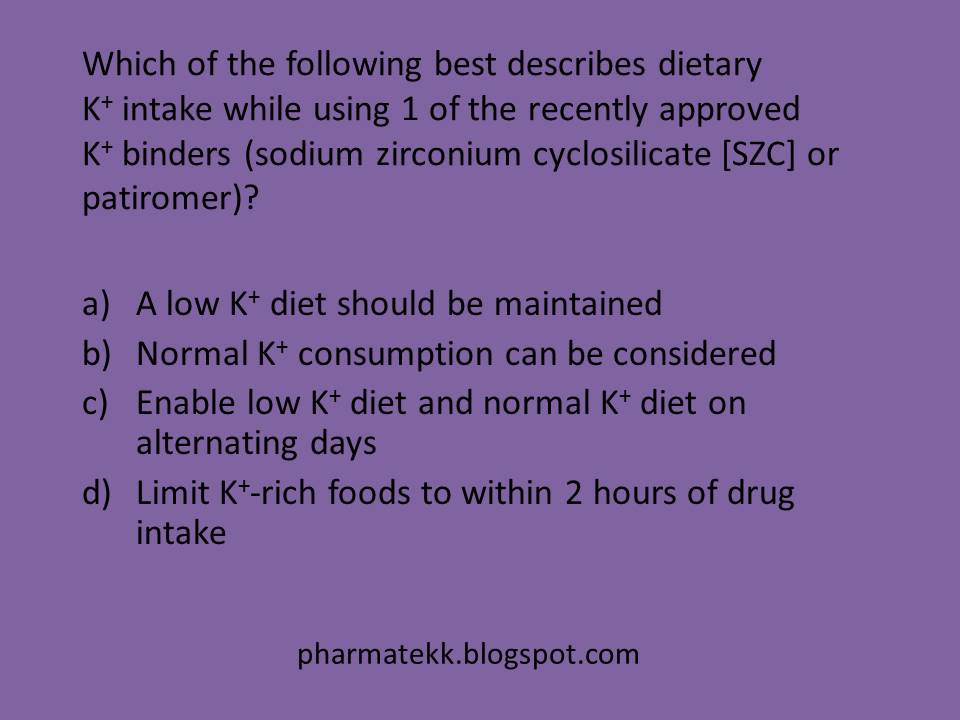
Potassium Binders In CKD


Answer: a- A low Potassium diet should be maintained.

The use of newer Potassium binders such as Patirometer and Sodium Zirconium Cyclosilicate (SZC) should be taken with low potassium diet in chronic kidney disease patients. The Potassium binders must be taken as prescribed without abrupt stopping due to rebound effects. A normal single Potassium diet causes spike in Potassium levels after one meal, so the implementation of Potassium restrictions on alternate days is not recommended.

Monday, 19 August 2019

Potassium Intake In Chronic Kidney Disease


Answer: c- 2-3g/ day
Salt intake should be limited to 2000mg/ day which is equivalent to 1 teaspoon a day and Potassium intake should be limit to 2-3g/ day depending on the stage of chronic kidney disease.

Sunday, 11 August 2019

Immunity to Measles


Answer: a- Documentation of at least 1 MMR Vaccine.

Pregnant women who are exposed to measles or suspected for measles are supposed to get 1 MMR vaccine for average risk and 2 MMR doses for high risk patients. A positive ELISA test suggests immunity to measles and in those cases PRNT is not needed to be conducted.

Friday, 9 August 2019

Measles Transmission


Answer: b- Persons are considered infectious from day four before the onset to rash to four days after the appearance of rash.

Measles have an incubation period of 7 to 21 days, but persons are infectious at day 4 before the onset of rash to four days after the appearance of rash, and the measles virus is airborne and infectious for 2 hours. The two doses of MMR vaccine are sufficient to provide immunity of around 97%, about 92%-95% of the population must be vaccinated for measles virus in order to prevent ongoing transmission.


Medicine For Attention Deficit Hyperactivity Disorder


Answer: e- Methylphenidate hydrochloride

Methylphenidate is a stimulant medication which is used to treat Attention Deficit Hyperactivity Disorder. It is first line treatment for ADHD. It can be given orally or applied to the skin, different formulations have different duration of action.

Tuesday, 6 August 2019

Stress Incontinence In Women


Answer:c- Duloxetine

Duloxetine is inhibitor of serotonin and noradrenaline re-uptake which was approved in UK as an add-on medicine for the treatment of stress incontinence in women where surgery was not preferred. The drug has great harms but not greater than the benefits.